Weekly Newsletters
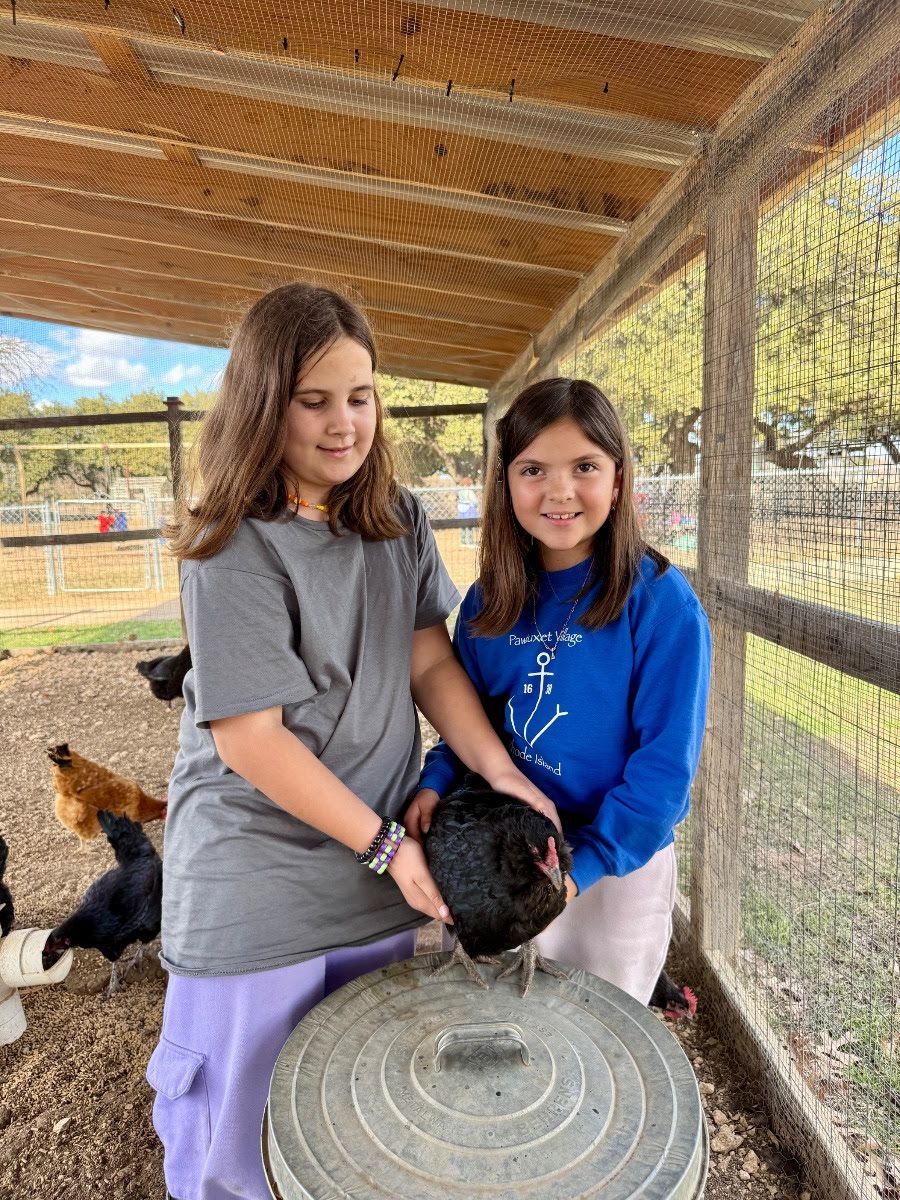
Kindness Shines All Around Despite of a late start, the Kindness Week is under way and our students don't shy away from helping and caring for others. We are so grateful for being a part of their education for life and proud of them for carrying kindness in their hearts everyday! Not only is kindness beneficial to our well - being and helps build relationships, it's also contagious and inspires others to share goodness. Our students are full of goodness and from modeling respect, giving lessons to classmates, caring for their environments to welcoming each other with a smile or conversation, sharing a presentation about something they have learnt or are passionate about, using grace and courtesy at school and at home. We need positivity in our world and the students are certainly bringing it all around our campus.
Our history is full of heroes who spent their lives educating and modeling justice, peace and equal rights for all. They are our inspiration and bring hope that the children of today will change our world in the near future into a better place. “Sooner or later all the people of the world will have to discover a way to live together in peace, and thereby transform this pending cosmic elegy into a creative psalm of brotherhood.” Martin Luther King Jr. was a person who led peaceful protests to stop discrimination based on the skin color. We teach our students about being equal, having the same rights as humans for voting, labor, access to public services like education. Dr. King received a well deserved Nobel Peace Price. "An eye for an eye only ends up making the whole world blind." Mahatma Gandhi was another peaceful activist for equal civil rights as well as leader of bringing India to the independence from Britain. He believed that people don't need to be divided because of their religious beliefs, rather there should be a freedom and tolerance toward various religious systems. When we talk to our elementary age students about fundamental human needs, we characterize material and spiritual needs. Religion, vanity and art belong to the spiritual category which is such important part of humans. "Being of service is not enough. We must walk the talk, live the talk, be the talk." Cesar Chavez was a civil right and labor leader for farm workers. Because of him establishing a union, the workers had gained safer work conditions, benefits like health insurance and better earnings. Chavez increased awareness among the farmers about being treated with respect, having dignity and standing up for their rights. Our students receive respect, are expected to show respect to others so we can function as a community with freedoms and responsibilities. "One child, one teacher, one book, and one pen can change the world." Malala Yousafzai is an activist for woman and children education who received a Nobel Peace Prize at 17 years of age. Malala is an inspiration for us, educators, because we know that our students can achieve whatever they put their minds into and an example for all our youth to stand up for what's important to them. "We shall walk together on this path of life, for all things are a part of the universe and are connected with each other to form one whole unity." Maria Montessori believed in educating children about living in a community where everyone practices self - control, respect, empathy, harmony and peaceful conflict resolution. Through the prepared environment, modeling and teaching grace and courtesy, mixed ages, supporting the growth of the moral compass in the elementary age children, care and work in nature, the concept of peace becomes a part of the child. Our Annual Kindness Week is January 26 - 30. Children and guides are planning for activities with their classmates, other classroom communities, their own families and the larger community outside of CMS. The guides will share more information with you in the Friday email.
“Children are so responsive that if you treat your child with kindness and consideration he too will be kind. If you let him pursue his own little affairs and interests undisturbed, you will find that he will be less inclined to disturb yours. Try to interfere with him as little as possible, there is no need to worry about him growing up ignorant or ill-mannered. Instead he will be observant and intelligent, independent and persevering, and these qualities lie at the root of personality." - Maria Montessori Speaks to Parents We can all agree that kindness is an essential value in life. When children practice kindness from an early age, it helps strengthen their emotional intelligence, build self-confidence, and develop problem solving skills. Kindness also supports healthy relationships and helps children become more resilient as they grow. These early experiences lay the foundation for how they connect with others and navigate life’s challenges. In Montessori education, kindness is nurtured within a mixed-age community where children learn to contribute to their environment, resolve conflicts collaboratively, and support one another. Adults model respectful communication and care for others, including animals and plants, helping to foster a culture of peace and empathy. We teach children to look beyond themselves, beyond the boundaries of our country and culture to respect and value people of all races and religions. Children are guided to use positive language, learning that if they do not have something kind to say, it is best to pause and keep those thoughts to themselves. Respect is a key component of our Montessori classroom. We regularly discuss respect for adults, classmates, classroom materials, and for oneself. Guides and assistants support children in developing these skills through clear communication, the use of “I” messages, positive modeling, and empathy. Consistent classroom management is essential in a Montessori environment. Children are taught not to shout across the room, but instead to walk over and speak quietly to one another. During work time, respect also means using materials as they have been shown and allowing each child the uninterrupted time they need to focus, concentrate, and complete their chosen work. Our Annual Kindness Week is January 26 - 30. Children and guides are planning for activities with their classmates, other classroom communities, their own families and larger community outside of CMS. The guides will share more information with you in the Friday email.

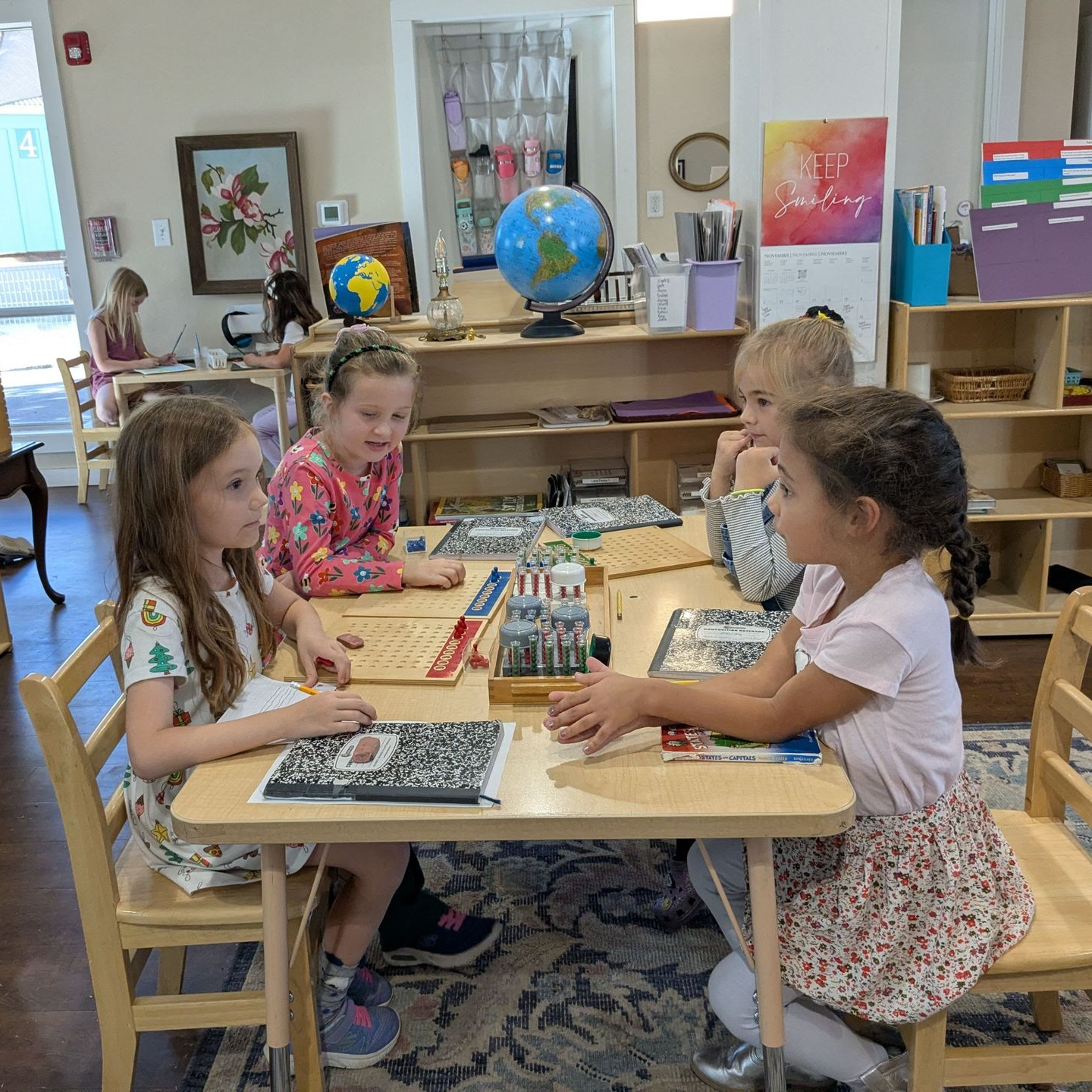
Welcome back to the Spring Semester and to 2026! We are looking forward to our time with the children and all their families! Let's talk about obedience. Dr. Montessori studied how children develop self-control and described this process as stages of obedience. Obedience is often thought of as children following rules set by parents or teachers in order to earn rewards or avoid consequences. Self-control, however, comes from within, it is a child’s internal motivation to do the right thing and meet expectations. In Montessori education, children begin by following rules and guidance from adults, and over time this naturally develops into self-control as they grow and mature. The stages of obedience are closely connected to a child’s age and development. For children under three, their sense of will is just beginning to emerge. At this stage, they are naturally drawn to what interests them in the environment and often act on instinct and impulse. This is why it is essential for adults to set clear and consistent boundaries, gently redirect unwanted behaviors toward appropriate ones, and model the language and actions they want children to learn. In a Montessori classroom, this stage is further supported through a carefully prepared and orderly environment. Children are offered practical life activities that are meaningful and purposeful, helping them develop independence and learn appropriate ways to engage with their surroundings. The second stage of obedience typically begins after the age of three and can last for several years as a child’s will continues to develop. During this time, children become more engaged with their surroundings and increasingly interested in social interactions. The adult’s role is to provide meaningful interactions, offer plenty of opportunities for practice and repetition of lessons, and support the child in developing deeper concentration and enjoyment in their work. Guidance through Grace and Courtesy lessons helps children learn respectful, kind, and appropriate ways to interact with others. The final stage is when true self-discipline can be seen. At this level, children act from internal motivation. What they do and how they behave brings them a sense of fulfillment, happiness, and purpose. Children naturally enjoy being helpful, staying engaged, and feeling that they belong. Having specific responsibilities allows them to contribute meaningfully to their family, group, or community. At this stage, adults continue to play an important role by guiding children to make thoughtful choices and helping them understand that self-discipline is a lifelong skill, one that adults also continue to practice and develop. Today is the 119th anniversary of the first Casa Dei Bambini opened in Italy. Some ways of celebrating for our students was using the stamp game to figure out what year it was when it opened. See the pictures below!

"Light a candle for peace, light a candle for love, light a candle that shines all the way around the world. Light a candle for me, light a candle for you, so the wish of world peace will one day come true!" This is one of the songs that Lower Elementary children presented at the Winter Concert last week. It was a wonderful event coming together once again as a community; many younger children were truly inspired by their older schoolmates. It's hard to believe that we are at the end of the fall semester! There has been so much learning, growing independence, taking ownership of work and responsibilities, building connections and inspiring one other for the children and the adults at CMS. This is also a season of giving and sharing. With the money earned at the International Festival, the Cypress students have purchased food for the Animal Shelter and donated it last week. Thank you for your support! As we approach the end of the year, it’s natural to pause and reflect. This year has brought many changes, and with change comes growth. While we learn from our challenges, we also know that looking back can keep us from moving forward. I am truly grateful for our CMS community; the children who are the future, the families who trust us every day, and the dedicated staff who work so hard to make each day the best it can be. The changes we’re making are for the better, and I believe our strength comes from working together.

"As different as we are from one another, as unique as each one of us is, we are much more the same than we are different. That may be the most essential message of all, as we help our children grow toward being caring, compassionate, and charitable adults." - Mr. Rogers In our Montessori community, celebrations bring opportunities to practice tolerance, gratitude, and appreciation of diversity. Through stories, music and art, the guides share information about various global festivals and fiestas like Diwali, Day of the Dead, Lunar New Year, Thanksgiving, Hanukkah, Kwanza or Eid. Learning about those fosters peace, inclusivity and builds connections among classmates. More commercial in nature celebrations like Halloween or Valentine's are left to be enjoyed outside the school environment. Birthdays have a very specific way of being shared with the child’s community. Through the “Walk Around the Sun” the child holds a globe and walks in a circle as many time as their age is. This can be emphasized by sharing pictures and milestones or events in the child’s life. Instead of focusing on receiving gifts, the child has an opportunity to give back to their community by donating a book, a plant or some supplies. Older classmates might create cards or write letters to the birthday child. Grace and courtesy lessons allow for modeling an invitation to join, introducing oneself, polite conversations, usage of cutlery and cloth napkin, offering food and drink or maintaining eye contact. Practical life activities prepare the child to be an independent and contributing community member, one who can prepare decorations for the celebrations and assist in getting food items ready for family and friends.

Dr. Montessori observed that people of all ages tend to behave in certain predictable ways. She called these natural patterns “human tendencies.” They guide us throughout life and support our physical survival, emotional well-being, and overall development. Maria Montessori identified many of these tendencies, including: orientation, exploration, order, imagination, activity and movement, self-perfection, communication, association with others, and many more. These tendencies are always present, and Montessori education is designed to nurture them in healthy, meaningful ways. Orientation is the process of adjusting to a new place or group and learning to feel comfortable and at home in that environment. Emotionally, orientation involves understanding the expectations and routines of the community where everyone feels respected, shares responsibilities, and can grow toward independence. Exploration is the natural tendency that drives us to learn about the world and seek answers to our questions. We explore through observing, researching experimenting, and discovering. As we broaden our understanding, we construct ourselves as individuals, as well as our societies and cultures. In early childhood exploration happens through the senses while the elementary age children expand their exploration through imagination and “Going Outs” where they learn from real experiences in the community beyond the classroom. Order is essential from the moment a child is born. Having order in their surroundings helps children develop the internal structure they need to feel secure and function well in any situation. This includes keeping the environment organized, establishing predictable routines, and taking responsibility for personal belongings. These simple habits support the development of intellectual growth. Both physical and mental order play a key role in building strong executive functioning skills which are vital for success in school, work, and everyday life. Imagination is the ability to create mental images based on real experiences. It includes curiosity, creativity, and the capacity to combine memories and observations to form new ideas. Thanks to imagination, early humans were able to develop clothing, shelter, transportation, and forms of communication. Today, the same human imagination continues to drive innovation and make what once seemed impossible become reality. Activity and movement involve using both the body and the mind, our hands and our thinking, to engage with the world around us. Through purposeful activity, children develop important skills that help them become productive, independent, and confident. In Montessori, we often refer to this activity as “work,” because it supports a child’s growth and self-construction. Just as the hand cannot work without the mind, the mind cannot fully develop without the work of the hand. Self-perfection is the tendency that drives us to keep improving in all areas of life. Throughout history, from simple shelters and stone tools to skyscrapers and modern technology, humans have continuously sought to make things better. This desire to refine, improve, and progress is a powerful force that helps us grow as individuals and as a society. Communication allows us to share ideas, feelings, and opinions, helping us build meaningful connections with others. We communicate in many ways, through gestures, spoken words, writing, music, art, and more. Humans are naturally wired to communicate; even infants express their needs from the very beginning. As children grow, their communication becomes more sophisticated, and they develop a deeper ability to understand others, including reading body language and social cues. Association with others refers to the connections we form with groups and communities, and the way we learn from their shared knowledge and experiences. Humans depend on one another, and together we create a global community. Feeling a sense of belonging is essential, it helps us thrive, contribute meaningfully, and share responsibilities within the group.

G - GROWTH MINDSET Helps children understand that their abilities can improve with effort, persistence, and practice. In our classrooms, we support this by giving children choices in their learning, encouraging them to learn from mistakes, focusing on the process rather than the final product, and helping them reflect on their progress. Having a growth mindset teaches children to be resilient, solve problems, stay motivated, and believe that hard work leads to success. When a child feels frustrated and says, “I can’t do this,” we gently remind them, “You can’t do it yet,” “You should be proud of your effort,” or “That’s a creative way to solve that problem! ”A growth mindset is not only important for children also adults need it to continue learning, improving, and overcoming life’s challenges. R - RESPECT We teach respect by modeling the behavior we want children to learn and by giving lessons in grace and courtesy. This helps children learn to respect themselves, others, and their environment. When we honor each child’s individuality and abilities, they begin to develop self-respect which is an essential foundation for confidence and pride. Adults show respect for a child’s concentration by observing quietly without interrupting. When a child makes a mistake, we often give them the opportunity to figure out the solution on their own instead of correcting them right away. Rather than punishing negative behavior, we gently redirect it. For example, if a child hits, the adult might say, “I can’t let you hurt your friend. I’m going to sit here between you,” while calmly setting a clear boundary. Respect begins with simple actions like offering a toddler your hand to guide them and grows as we continue to give children meaningful choices throughout their lives. A - ADAPTATION Is a lifelong process in which people learn from and respond to their environment. For children, this includes both the unconscious way they absorb the language, culture, and routines around them, and the conscious skills they develop through independence, work, and social interactions. In our approach, we also adapt the classroom environment and materials to meet each child’s individual needs. Young children have what Dr. Montessori called the absorbent mind , a remarkable ability to naturally take in everything from their surroundings. Because of this, the structure and tone of the classroom matter. Freedom within limits helps children understand expectations and follow community rules so everyone can feel happy, productive, and a true sense of belonging. Adjusting to how things work in a Montessori classroom takes time. Adults guide children patiently, with repetition and gentle boundaries, sometimes limiting freedoms until the child is ready to handle them independently. Instead of saying “Don’t run,” we say, “Walk, please.” Instead of “Don’t drop it!” we say, “I know you can carry the tray like this.” These positive, encouraging statements help children build confidence and take ownership of their actions. T - TEAM WORK Develops naturally in a Montessori environment. Mixed-age classrooms allow older children to mentor younger ones, and collaborative projects give students opportunities to share responsibilities and work toward common goals. Children also practice teamwork during daily practical life activities, caring for the classroom environment, participating in group games, and learning conflict resolution skills. These experiences help build empathy, cooperation, and a strong sense of community. The adults in the classroom, both the guide and the assistant, model teamwork by staying consistent, communicating clearly, and supporting each other. When a child needs extra support, collaboration becomes even more important. School staff, parents, and outside professionals may all work together to ensure the child’s success. True teamwork involves dividing tasks, communicating effectively, meeting timelines, and using each person’s strengths for the benefit of the group. Children in a Montessori environment practice these skills every day, helping them grow into confident leaders who can work well with others while staying flexible. I - INCLUSION In an inclusive community, every child, regardless of background, ability, or identity, feels safe, valued, and respected. Inclusion means creating an environment without barriers, honoring each child’s unique strengths and cultural heritage, and adapting learning to meet individual needs. What makes our CMS community truly special is the diversity of children and families who come together in one place. By embracing the many cultures represented in our school and their aspects such as different languages, beliefs, and customs, children build friendships, learn from one another, and gain unforgettable experiences. These daily interactions foster understanding, acceptance, and a deep sense of belonging for everyone. T - TEACHING ONE ANOTHER In Montessori classrooms, children develop empathy, patience, and respect for others’ work simply by learning together. Because our classrooms include a mix of ages, older children naturally become mentors, helping guide younger classmates. Younger children learn by watching and imitating older peers, while older children strengthen their own understanding by teaching what they know. This dynamic creates a warm, supportive community where everyone grows together. Even in the toddler environment you can hear phrases: “Help me, please” between the classmates while in Children House: “Do you need help?” becomes a frequent offer among the peers. In the elementary environments teaching one another inspires the children to explore their interests further and creates common goals which might begin a business project or support the needs of larger community outside the classroom and solve problems in innovative ways. U - UNIVERSE Dr. Montessori believed that Cosmic Education was the ideal way to introduce children to the wonders of the universe and help them understand how everything is connected. She recognized that elementary aged children are naturally curious, imaginative, and eager to explore big ideas thus making this stage of development perfect for discovering these relationships and seeing their place in the world. In her book, “To Educate the Human Potential”, Dr. Montessori says, ". . . let us give [the child] a vision of the whole universe. The universe is an imposing reality, and an answer to all questions . . . all things are part of the universe, and are connected to each other to form one whole unity." D - DIVERSITY We promote diversity by offering a curriculum that includes multicultural materials, activities, and lessons focused on peace, respect, and empathy for people around the world. This approach helps children develop a strong sense of community both within the classroom and in the larger global community. A diverse learning environment exposes children to different cultures, perspectives, and experiences. This enriches their critical thinking, encourages them to see the world through multiple viewpoints, and helps them develop an understanding of fairness, equity, and social responsibility. E - EMPATHY Children who develop empathy are better at making friends, working with others, and resolving conflicts peacefully. Learning to “put themselves in someone else’s shoes” helps them understand how others might feel and respond thoughtfully. Imagine a child noticing a friend is sad and offering a kind word or sharing a toy, that’s empathy in action which we encourage in daily interactions . Building emotional intelligence, the ability to understand and manage both their own emotions and the emotions of others, equips children with a key skill for navigating life successfully. Handling challenges, building strong relationships, and growing into thoughtful, caring adults begins early a through the guidance of loving adults.

The International Festival that takes place at CMS every fall, is a gathering of families from all around the world to learn about other people and places that each classroom has been preparing to share. It’s such a fun and enriching experience, and this year we have travelled from Venezuela, India, Egypt, Japan and China through Spain, Ukraine, Italy, France and Canada. It was wonderful seeing everyone and if you missed it, mark your calendars for next year! Diversity in a Montessori Classroom At Montessori schools, diversity is more than a value and it’s a daily practice. We celebrate differences in culture, language, family background, and ability to help every child feel welcome and valued. By learning about the world and the people in it, children develop empathy, respect, and an understanding that we are all connected. How We Foster Diversity at CMS Through a culturally rich curriculum: Children are introduced to stories, songs, and activities from many cultures and traditions. This helps them appreciate both what makes people unique and what we share in common. With an inclusive environment: Our classrooms are designed to make every child feel seen and respected. The materials, books, and visuals we use reflect the diversity of the world around us. Using diverse learning materials: Montessori materials are thoughtfully chosen to represent a variety of people, family structures, and communities so that all children can see themselves in their learning. Practicing peace and communication skills: Through practical lessons in kindness, problem solving, and cooperation, children learn how to navigate differences and build strong, caring relationships. Vast representation in staff: Many Montessori schools also work to hire and support educators from diverse backgrounds, giving children a broader range of role models.

Educating children is one of the most meaningful and rewarding journeys we can embark on and also one of the most demanding. The Montessori approach offers a unique way of teaching that nurtures critical thinking, communication, collaboration, and creativity, skills that are essential for success and leadership in the 21st century. At the heart of Montessori education is a belief that learning should be a lifelong passion. We aim to inspire children with a love of discovery that continues well beyond the classroom. From their earliest experiences, Montessori students are encouraged to be curious, flexible, and adaptable. They learn to work in diverse environments, develop self-confidence, and continually seek personal growth. These qualities prepare them not only to participate in the world but to lead and innovate within it. Throughout the day, children of all ages have many opportunities to communicate and collaborate. Whether they’re working together on a project, planning an activity, solving a disagreement, or helping a classmate, they’re constantly learning how to express themselves respectfully and listen to others. Using “I” statements, sharing ideas, and finding solutions together helps them develop empathy which is a key quality of strong, compassionate leaders. Critical thinking and creativity naturally grow in the Montessori classroom. The hands-on materials encourage children to explore, experiment, and self-correct. From fitting puzzle pieces together to discovering why a process didn’t work as expected, children learn through doing and reflecting. Their curiosity drives them to ask “why” and “how,” to explore new perspectives, and to understand complex concepts at a deeper level. This process of exploration and reflection helps Montessori students become confident problem solvers and innovators who approach challenges with clarity, curiosity, and care. By fostering independence, empathy, and a genuine love of learning, Montessori education equips children with the tools they need to shape a better future.

Experts believe that 65% of children starting primary school now will work in jobs that don’t exist today. Tomorrow’s workforce will need to be more adaptable than ever before and work-life balance will only become more important. By encouraging critical thinking and confidence, Montessori education prepares children not only for the modern workplace, but for life. We believe that education is about optimizing human capacity, not simply acquiring knowledge and taking exams. ( Louise Livingstone, "The Magic of Montessori – 5 Things That Make Montessori Special" ) The Montessori Model United Nations (MMUN) program is one way we are preparing students for future success. This remarkable program is for students ages 9 to 15, and offers them the chance to participate, either online or in person, in thoughtful debates about current global issues and to propose real world solutions. Dr. Maria Montessori observed that children at this age are deeply sensitive to fairness and justice. MMUN builds on this natural empathy by guiding students through a year long learning journey. With the support of their teachers, students research their assigned country, study global topics, and prepare speeches and resolutions. At the end of the program, children come together with Montessori peers from around the world to engage in formal debates, representing their countries and presenting their solutions to international challenges. This unique experience helps these young people develop essential life skills such as critical thinking, academic writing, public speaking, collaboration, negotiation, and leadership. At the same time this opportunity aids in nurturing a sense of global citizenship and social responsibility. The United Nations (UN) was created after World War II to advocate for peace, defend human rights, and support global cooperation. The UN headquarters is located in New York City, and MMUN participants have the unforgettable opportunity to gather and debate in the actual General Assembly Hall, where world leaders meet to shape the future. MMUN conferences are well regarded for their academic rigor and high standards and can help students strengthen their college and job applications. This fall, our 5th and 6th graders, assisted by Lynn O'Connor and Piya Dasgupta, are hard at work preparing for the 2026 MMUN conference. We are cheering them on and are looking forward to their finale!

While Texas weather doesn’t always showcase the full range of the four seasons, this time of year still brings a gentle taste of autumn. We begin to notice small but meaningful signs: the leaves shifting in color, cooler mornings touched with dew and fog, acorns scattered on the ground, and of course pumpkins making their annual appearance. Exploring these objects offers a wonderful opportunity to naturally introduce lessons in language, math/geometry, biology, art, and music. These seasonal changes, even when subtle, offer rich opportunities for children to connect with nature. Time spent outdoors helps children develop a deep sense of wonder, curiosity, and peace. It nurtures respect for all living things and teaches patience as they observe the slow, intentional rhythms of the natural world. In our elementary classrooms, children explore these ideas through lessons like the “Timeline of Life,” where they learn that every living being has a purpose and that purpose is often to serve and support others. Even our youngest learners in Casita are drawn to observing insects at work, plants growing, and the way each part of our ecosystem depends on another. Through these experiences, children not only grow in knowledge, but in empathy and a sense of belonging within the larger world around them. Caring for the natural environment allows us to make meaningful contributions today while ensuring that future generations can continue to enjoy the beauty of our planet including the wonder of seasonal changes. “There is no description, no image in any book that is capable of replacing the sight of real trees, and all the life to be found around them, in a real forest... The wood reveals that it is not only the trees that exist, but a whole, interrelated collection of lives.” Montessori, From Childhood to Adolescence

In Montessori education, care of self and care of the environment are key components that help children build independence, responsibility, and respect for themselves and others. From a very young age, children are encouraged to do things for themselves like feeding, dressing, brushing teeth, toileting, and preparing simple snacks. These tasks may seem small, but they help children develop important life skills such as coordination, concentration, and confidence. As they grow, children take on more responsibility, like packing their own lunch, choosing their clothes, or helping a sibling. Alongside self-care, children also learn to care for their environment. Even toddlers participate by setting the table, sweeping, watering plants, and tidying up. These activities teach children that their actions impact the shared spaces around them. For example, forgetting to water the plants can cause them to wilt, or not putting away materials can make it harder for others to work. Montessori classrooms are carefully prepared to support these activities. Children learn that keeping things clean, organized, and beautiful benefits everyone. They experience a deep sense of belonging and pride in contributing to their community, skills that carry into life at home and beyond. By encouraging care of self and the environment, Montessori education fosters capable, respectful, and thoughtful individuals who are empowered to make a positive impact in their world.

From an early age, children absorb societal expectations about behavior, appearance, and belonging. When they don’t fit typical norms, they can sometimes be teased or misunderstood. In Montessori classrooms, children grow within a carefully prepared environment, a “mini-society” that values respect, empathy, and community. Guides model grace and courtesy, helping children learn how to communicate and resolve conflicts peacefully. When safety isn’t a concern, adults observe from a distance, allowing children to practice problem solving and self-regulation. Through daily work and play, children are encouraged to consider others’ perspectives and reflect on how their words and actions affect those around them. The diversity of ages, backgrounds, skills, and personalities makes our classrooms vibrant and inclusive spaces for learning. Montessori classrooms have clear anti-bullying policies, emphasizing kindness, safety, and mutual respect. Guides intervene only when necessary to prevent harm, using redirection or calming strategies, and families are partners in supporting these values at home. Every report of unkind behavior is taken seriously to ensure that each child feels secure, valued, and part of a caring community. When children are surrounded by compassion and guided with respect, they learn to extend that same care to others. Together, we’re helping raise a generation of confident, empathetic young people who understand that kindness truly matters.
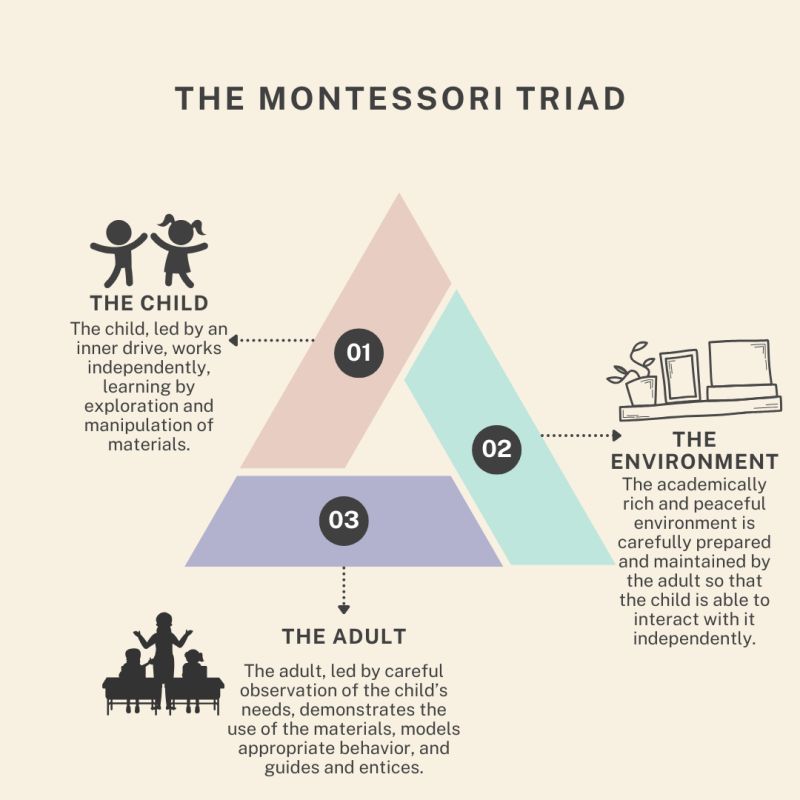
Two week ago we explored the work of the adult in our Montessori classroom, and last week we reviewed the work of the child. This week we want to present the third part of the learning triangle: The Montessori Environment.

The work of the child in Montessori education is purposeful and self-driven, guided by exploration and focused on process rather than product. From birth to age six, children concentrate on self-construction; between six and twelve, they develop intelligence and morality; adolescents, ages twelve to eighteen, seek identity and peer connection; and young adults, eighteen to twenty-four, work toward economic independence and finding their place in the world. At every stage, Montessori supports the development of the whole child, fostering independence as well as physical, social-emotional, and cognitive growth. From refining motor skills and engaging the senses, to preparing for advanced learning in math, science, and language, to exploring culture, art, and music, Montessori education weaves together all areas of learning in an interconnected web.
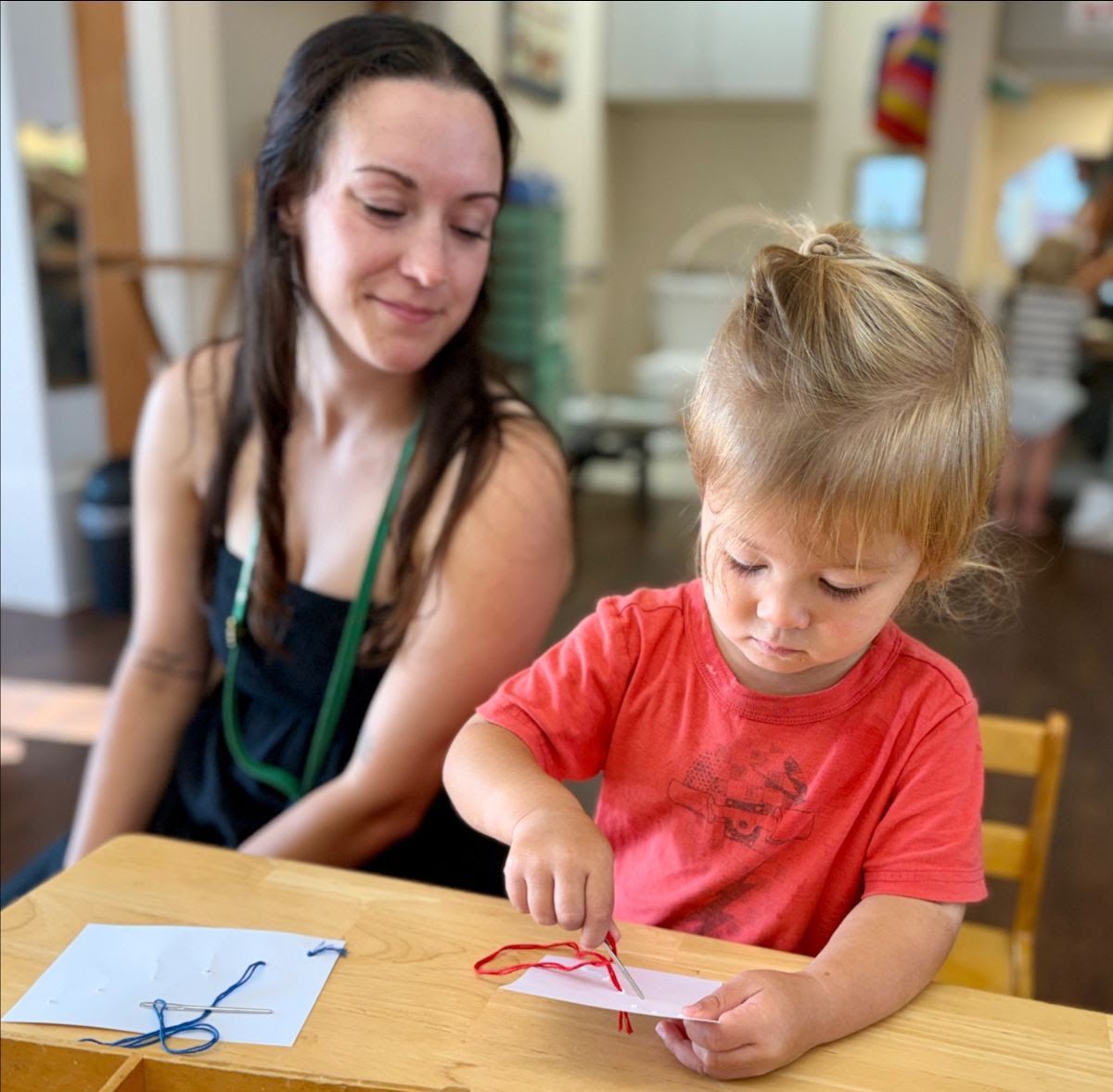
In Montessori classrooms, the role of the adult is to prepare, model, and guide. Preparation takes place on three levels: 1) Physical, which can be seen in the environment and through self-care. 2) Intellectual, engaging in continued education and pursuing personal interests that can inspire students to explore new ideas. 3) Spiritual by fostering patience and humility in oneself through observation of the children and self-reflection. Modeling is essential. When adults consistently demonstrate compassion, kindness, helpfulness, and care in both words and actions, children naturally absorb and reflect these qualities in their own behavior. Guiding is different from teaching. In Montessori, the materials are the teachers. The adult’s role is to connect the child with the work, offer choices, and ensure ample opportunities for practice, allowing the child to experience accomplishment and growth from within.

Physical Education In today’s world, where children are increasingly leading sedentary lifestyles, the integration of movement and sports is more important than ever. While movement is naturally embedded in Montessori education there is a growing need for a structured and comprehensive approach to physical activity. Krystalyn Perry is our Redbud Community Assistant and P.E. coach at CMS! Krystalyn has completed the Montessori Sports Fundamentals Course, an AMI-accredited training program designed to deepen understanding of how sports and movement align with Montessori education. A key part of P.E. is learning and practicing good sportsmanship. It teaches students to respect one another and to work together, recognizing that everyone has an important role in the group. Just as important is developing emotional control in situations that call for empathy, reasoning, and collaboration. Sportsmanship builds character, strengthens relationships across all skill levels, and fosters resilience that extends beyond the sports field into academics, work, and life. It also teaches fairness, integrity, and how to handle both wins and losses with grace, encouraging a healthy outlook on competition and challenges. P.E. for CMS elementary students kicked off last week with team building activities and Krystalyn has plans for soccer, kickball, fitness circuits, basketball, volleyball, archery, and more this school year!

The Rotary Club of Georgetown is a service organization of professionals and leaders dedicated to humanitarian work, high ethical standards, and promoting goodwill and peace. One of their current initiatives is creating Peace Gardens in local schools. These beautiful spaces invite children to reflect and resolve conflicts peacefully. We are excited to share that CMS is on the list to receive a Peace Garden this school year! This is a wonderful opportunity to live out Maria Montessori’s vision of Education for Peace on our campus. Our elementary students have been invited to help design the garden, and once it is built, we will celebrate its dedication with our entire school community. Stay tuned for updates!

Getting Our Hands Dirty A Montessori environment isn’t complete without a beautiful garden! Across our campus, learning extends beyond the classroom as children dig in the soil, care for plants, and experience the joy of seeing their work blossom. This week, many classrooms have been busy cleaning and pruning garden beds, refreshing the soil, and planting for the fall and winter seasons. Guides are preparing lessons that deepen children’s connection with nature, and classrooms are sharing sign-up sheets seeking volunteers. Maintaining our beautiful 18-acre campus is truly a labor of love, but we can’t do it alone! If you have a green thumb, or simply enjoy spending time outdoors, we’d love your help. Please consider sharing your time, knowledge, or resources to support your child’s class garden.

CMS comes to life when children arrive! Our campus is buzzing with children of all ages. We've seen endless smiles and a few short-lived tears, but all are eager to reunite with their peers and teachers. We’ve loved welcoming new friends and look forward to meeting those who will be joining us in the coming weeks! Returning to school and settling back into daily routines is a process, and everyone’s timeline looks a little different. We value the individuality and unique personalities that make our school so special.

Welcome Back CMS Community! I hope that you all had a relaxing and fun-filled summer break. It sure went by fast, as it always does. We are super excited to have the children back later this week! It was lovely to see all who were able to attend the CMS101 and Parents Orientations last night. A special thanks to our office staff who worked tirelessly to assure that all the documents, information, and schedules were ready for you, and our academic staff also worked with a great effort the get the classroom environments ready. I hope you could feel the energy and excitement in the air.

As we wrap up another incredible year, we just want to say—thank you! From the first-day jitters to the end-of-year celebrations, it’s been a journey full of growth, joy, and memorable moments. To our students, families, and staff: you’ve brought kindness, positive energy, and enthusiasm to everything we’ve done. We couldn’t have done it without you! Now it’s time to close the books and soak up some sunshine. Have a fun, safe, and well-deserved summer break. We can’t wait to see you next year for more adventures!

Nature Studies Students in the Juniper Lower Elementary classroom are enjoying some special visitors to their classroom! They have silkworms in class to study this May. Students have been exploring the life cycle of these fascinating creatures and observing them in their "prepared environment"! Visiting Children's House full cycle students also got to see them on a visit to the classroom.

TEACHER APPRECIATION WEEK It's Teacher Appreciation Week at CMS and our Class Ambassadors have organized so many special treats for our staff. What a lovely way to show our staff how much we appreciate and value their work at school! The Guide in Montessori education is a unique position and we are so fortunate to have MANY talented individuals in this role at CMS. Add to that all the amazing individuals on campus who are supporting and assisting in their work with students. It truly does take a village and we are grateful everyday for our CMS village!

Yes, we've seen the rain chance in the forecast but this is our last chance to host this annual celebration and we don't want to miss it. If showers seem likely, we have pop-up tents on hand and we plan to utilize our covered walkways as much as possible. Fry's Family Farm will have a variety of small animals to interact with and hopefully tractor rides in the field. We'll have some music from Marshal and also from students in Upper Elementary, as well as fun sale items from the adolescent class. Hope to see you Friday at 3:15 in the CMS Courtyard!

Last Call for Yearbooks & Prints Today is the last day to order prints from The Latest Photo! Look for the blue button below. Yearbook orders are due by Friday, April 25th.

CALENDAR REMINDER CMS is closed on Friday, April 18th and Monday, April 21st

The Community Montessori Yearbook is a wonderful keepsake for children and parents. This full color book is available by pre-order only and will be delivered to your child's classroom before the end of the school year. Yearbooks include professional student photos, class photos, candid shots, and more! Order deadline is April 25th!

It's Conference Time! This week, CMS is closed on Friday for Conference Day. We set aside this valuable time so guides and parents can come together on behalf of the child. If you haven't signed up to meet with your child's guide - do it today! I recall from my own experiences as a guide for many years that most of the time parents wanted to know if their child was progressing and if they were connecting socially with others. While every child, family, and school year is different, I would venture to guess that still holds true. Conferences are a great time to press pause, reflect on where the child has come from, and also look forward to where they are heading. There's tremendous value in connecting as a team with the common purpose of preparing the child for life.

GOOD EARTH CELEBRATION RE-SCHEDULED! With rain in the forecast for Thursday and Friday, we are re-scheduling the Good Earth Celebration. Please mark your calendar for Friday, May 2nd and plan to attend! Fry's Farm will be here with their amazing adorable animals! We'll also have tractor rides, a Nova community sale, and drumming with Marshal. See you then!

Spring Break is right around the corner and the weather has been amazing! I hope you are all planning some outdoor adventures next week. Whether large or small, any time you take it outside you are providing that necessary "VItamin N" of nature. The health benefits are well known but let's not forget there are emotional benefits too in bringing us calm and restoring our sense of joy and wonder. The feel of sand and dirt, the warmth of the sun, the brightness of the blue sky - simply expressing and admiring these things with your child can bring connection as well. Look at those lovely clouds overhead as the Lower El students are enjoying PE! Can you name them? hint at the bottom of this page!

The Self Driven Child “We really can’t control our kids—and doing so shouldn’t be our goal. Our role is to teach them to think and act independently, so that they will have the judgment to succeed in school and, most important, in life. Rather than pushing them to do things they resist, we should seek to help them find things they love and develop their inner motivation. Our aim is to move away from a model that depends on parental pressure to one that nurtures a child’s own drive. That is what we mean by the self-driven child.” - William Stixrud, The Self-Driven Child: The Science and Sense of Giving Your Kids More Control Over Their Lives Our next CMS Parent Book Club meets this Thursday after drop off at 8:20 . Join us in the Clubhouse for a lively discussion of this amazing book. I'll be joined by both Cindy Ma, Children's House Level Coordinator & Guide, and Veronica Rodriguez, Elementary Level Coordinator & Coach. Bring your coffee and settle in for a great chat. A nice way to start the day! *Note that Part 1 covers the first half of the book and next week (March 13th) we'll discuss the second half of the book. RSVP so we know how many chairs to put out. If you haven't had a chance to get the book yet - still come! The conversation will still be meaningful for you!

Our Parent Book Club is back with a new recommended read! The Self-Driven Child by William Stixrud and Ned Johnson. This book comes highly recommended by Kathy Minardi, a longtime leader in the AMI Montessori community, who has personally worked with the authors who are psychologists in the D.C. area. As we did for the Anxious Generation, we will talk about the book in 2 parts: March 6th - Part One covers Chapters 1 to 7 March 13th - Part Two will cover Chapters 8 to 14 We will meet right after morning drop off this time. Please RSVP and plan to join us in the Clubhouse from 8:30 to 9:30am. If you can only make one of the times, still come! And if you prefer podcasts, here's a LINK to the author's page for that. Looking forward to seeing you all there!

COLD WEATHER ALERT! There is a Cold Weather Advisory for our Georgetown area starting tonight and going thru Thursday. The lows the next couple of nights will be well below freezing - which means the morning will be very cold too. Please be sure you send adequate cold weather gear for your child! I have not heard any information about ice or precipitation being part of this weather alert - just very very cold temperatures so school will be on as usual. If anything changes, of course you'll receive a text message & email from us. Stay warm!

Registration for Spring Enrichment classes ends tomorrow! Be sure to register your child now. Classes get underway the week of February 18th.

Thanks so much to everyone who sent in some change last week. Our Kindness Challenge school -wide was to collect for California Wildfire Relief. Students are busy counting and will have a going out to the bank next week. We'll keep you posted on our final total. If you missed it, no worries! Send a donation in on your own.

Send us your coins! For our Kindness Challenge this year we are collecting coins to help children and families impacted by the California Wildfires. Students can bring coins to their classroom at morning drop off or families can bring them to the office anytime! All week students are taking part in Kindness Challenges both big and small in class and out. Here some Nova students brought a book called Kindness Grows to read with some Children's House friends. Ask your child how they are being kind today!

Every year CMS students take part in the Great Kindness Challenge put on by Kids for Peace. Schools all over the world join together for a special week filled with activities geared to instilling kindness and creating a more peaceful world. Last year, CMS students collected coins to sponsor students at the Kids for Peace school in Kenya. We had such a great result we were able to help 35 children! This year, inspired by students in our Redbud classroom, we will be collecting coins to help children and families impacted by the California Wildfires. Take some time this weekend to start collecting! Students can begin bringing coins to class on Monday!

"Meaningful Work" looks different at different ages Last week we talked about the power of providing opportunities for children to engage in "meaningful work." Full engagement in such work is what brings out a focus or concentration that is similar to what Mihaly Csikszentmihalyi called FLOW. There's so much to say on that subject that he wrote an entire book about it! For our Montessori classrooms, we know that all those words describe a positive mental state experienced by a person who is completely absorbed in an activity. Time passes without being noticed and you emerge feeling refreshed, happy, and energized.

I hope you all had an excellent winter break - filled with relaxation and joyful times with family and friends. Yesterday the CMS staff returned to work with a full day of training and classroom preparations. We spent time reviewing social-emotional development across the ages and diving into effective tools to help children learn to navigate social conflict when it arises. It was a great way to refresh and prepare for the return of students today!

Final Day for Food Donations is Tomorrow! Our Season of Giving wraps up this week, as we head into our winter break. Class Ambassadors are collecting for Helping Hands of Georgetown for one more day. Please be sure to bring your donation by the end of the day tomorrow. Students can bring items to their classroom in the morning or families can drop off at the office any time up until 4pm. The most needed items are listed here but any non-perishable donation is welcome. Helping Hands runs a mobile food pantry that distributes food to those who need it Monday thru Thursday at 3pm, from the parking lot in front of the public library. Thank you for your donations!